Audience Demographics: Who You Can Reach
Both platforms skew toward 18–34-year-olds, but the overlap ends there.
| Metric | TikTok | |
|---|---|---|
| Global monthly active users | ~1.6–1.9 billion | 3.0 billion |
| Largest age group | 25–34 (35.3%) | 25–34 (31.6%) |
| Gen Z concentration (18–24) | 30.7% | 29.5% |
| Users 35+ | ~25% | ~40% |
| Avg. daily time spent | 52 minutes | 35 minutes |
| Largest market | United States (135–170M) | India (392–473M) |
| Gender split (global) | 54.5% male / 45.5% female | 50.6% male / 49.4% female |
What this means for budget decisions:
- If your target audience is 18–24: Both platforms reach this group, but TikTok users in this cohort are more engaged (52 minutes/day vs. 35) and the algorithm makes it easier to reach them without an existing following.
- If your target audience is 35+: Instagram has meaningfully better penetration. About 40% of Instagram users are 35 or older, compared to roughly 25% on TikTok.
- If you're targeting India or Southeast Asia: Instagram's user base in India alone (392M+) dwarfs TikTok's presence in most Asian markets. TikTok is stronger in Indonesia (107–165M users).
- If you're targeting the US: Near parity. Both platforms have 135–180M US users.
Content Formats: How Campaigns Actually Look
TikTok is a single-format platform. Instagram is a multi-format ecosystem. This distinction matters more than most marketers realize.
TikTok Content Formats
- Short-form video (15 seconds to 10 minutes): The only real format. Videos under 60 seconds get significantly higher completion rates.
- TikTok LIVE: Real-time streaming with direct product links. Growing fast for social commerce.
- Duet/Stitch: Reactive formats that let creators build on each other's content — unique to TikTok.
- Spark Ads: Brands can amplify organic creator posts as paid ads without creating new content.
- TikTok Shop: In-app purchasing with shoppable videos and LIVE commerce.
TikTok rewards raw, authentic content. Overproduced ads underperform. The algorithm decides distribution, not follower counts — which means a nano-influencer's video can outperform a celebrity's.
Instagram Content Formats
- Reels (up to 3 minutes): The primary discovery format. 59% of all creator content on Instagram is now Reels.
- Stories (24-hour ephemeral): The conversion workhorse. Polls, CTAs, link stickers, and discount codes drive action. Marketers allocate about 31% of Instagram budgets to Stories.
- Carousels: Multi-image slides with the highest save rate of any Instagram format. Best for educational and comparison content.
- Static feed posts: Declining in algorithmic priority but still relevant for brand aesthetics.
- Instagram Shopping: Shoppable tags in posts and Stories with product catalogs.
Instagram's strength is that different formats serve different funnel stages. Reels drive discovery. Stories drive conversion. Carousels drive saves and shares. A single campaign can use all three.
Engagement Rate Benchmarks
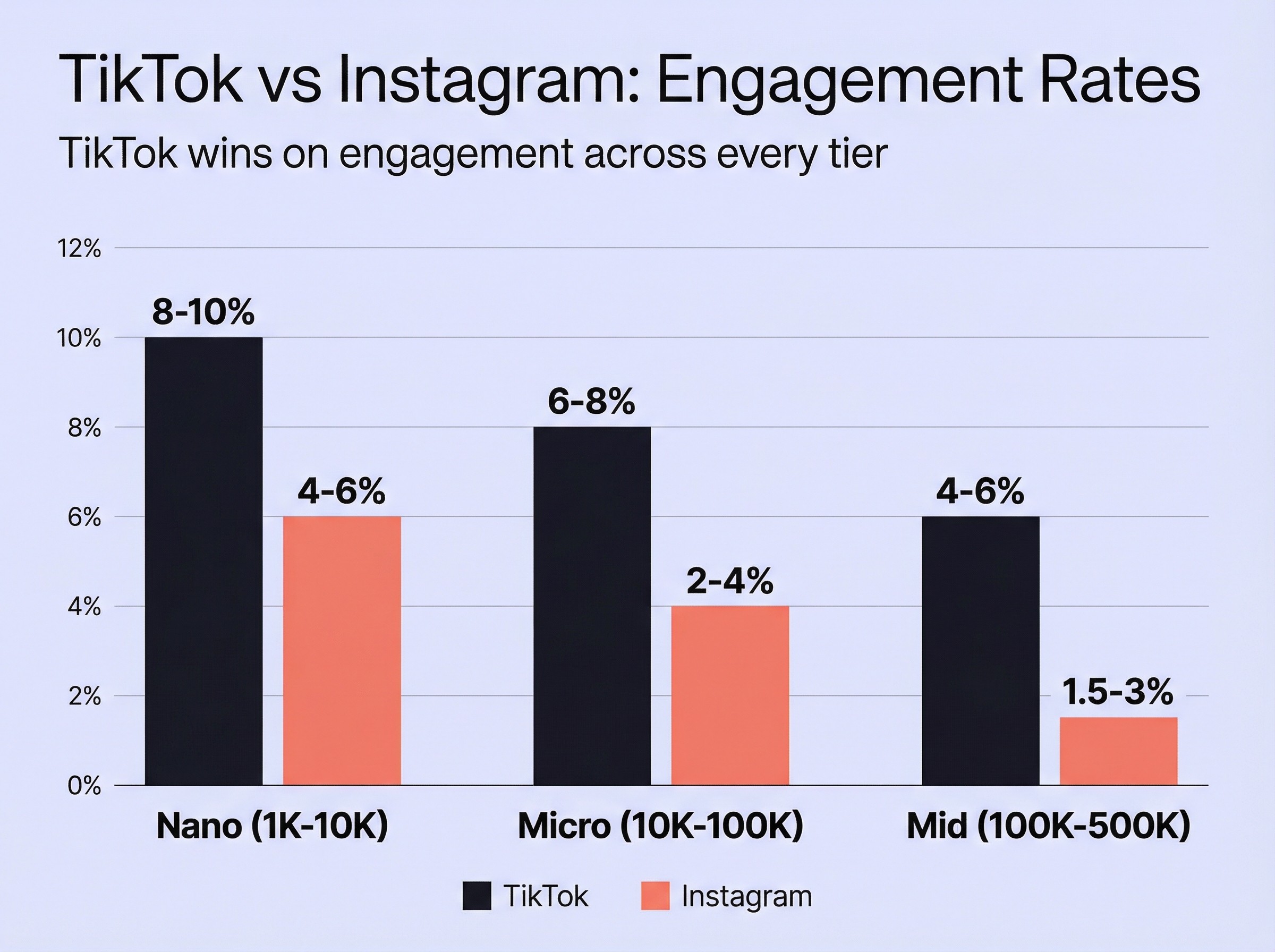
TikTok consistently outperforms Instagram on raw engagement metrics across every influencer tier. This is partly structural — TikTok's algorithm pushes content to non-followers, inflating interaction rates — but the gap is real.
| Influencer Tier | Follower Range | TikTok Avg. ER | Instagram Avg. ER |
|---|---|---|---|
| Nano | 1K–10K | 8–10% | 4–6% |
| Micro | 10K–100K | 6–8% | 2–4% |
| Mid-tier | 100K–500K | 4–6% | 1.5–3% |
| Macro | 500K–1M | 2–4% | 1–2% |
| Mega | 1M+ | 1–2% | 0.5–1% |
| Platform average | — | 2.5–3.3% | ~0.5% |
Context matters: TikTok engagement rates look 2–5x higher than Instagram, but they measure slightly different things. TikTok engagement includes views as the denominator (likes + comments + shares / views), while Instagram engagement is typically calculated against followers. A TikTok video might reach 10x the creator's follower count through algorithmic distribution, while an Instagram post primarily reaches existing followers.
The practical takeaway: if your campaign goal is raw awareness and interaction volume, TikTok delivers more per dollar. If your goal is reaching a known, loyal audience with high purchase intent, Instagram's lower engagement rates reflect a more targeted (and often more valuable) interaction.
What Influencers Charge: Cost Comparison
Influencer pricing varies by niche, audience geography, and usage rights, but here are the 2025–2026 market rate benchmarks for a single piece of content.
| Influencer Tier | TikTok (per video) | Instagram Feed/Reel | Instagram Story |
|---|---|---|---|
| Nano (1K–10K) | $50–$200 | $100–$500 | $50–$150 |
| Micro (10K–100K) | $200–$800 | $500–$5,000 | $200–$800 |
| Mid-tier (100K–500K) | $800–$5,000 | $5,000–$25,000 | $1,000–$5,000 |
| Macro (500K–1M) | $5,000–$25,000 | $25,000–$100,000 | $5,000–$20,000 |
| Mega (1M+) | $10,000–$50,000+ | $100,000–$1M+ | $20,000+ |
Key cost insights:
- TikTok is cheaper at every tier. Instagram Reels command roughly 30% higher rates than TikTok videos at the median. The gap widens dramatically at the macro and mega tier, where Instagram's longer history as the premium influencer channel sustains higher pricing.
- More than 80% of TikTok collaborations cost under $300, reflecting the platform's deep bench of nano and micro creators willing to work for product or modest fees.
- Instagram Stories are the best value on Instagram. They cost less than feed posts or Reels but often deliver stronger conversion rates for direct-response campaigns.
- Seasonal pricing spikes 20–30% around Q4 and major shopping events on both platforms.
Cost per engagement math: Even though TikTok influencers are cheaper per post, the cost per engagement (CPE) gap is even wider. A micro-influencer charging $400 on TikTok with a 7% engagement rate on 50K views delivers 3,500 engagements at $0.11 CPE. The same tier on Instagram charging $2,000 with a 3% engagement rate reaching 40K people delivers 1,200 engagements at $1.67 CPE. TikTok wins on efficiency — but Instagram's engagements may be higher-intent.
Campaign Types: What Works Best on Each Platform
Not every campaign type performs equally on both platforms. Here's where each excels.
TikTok's Strongest Campaign Types
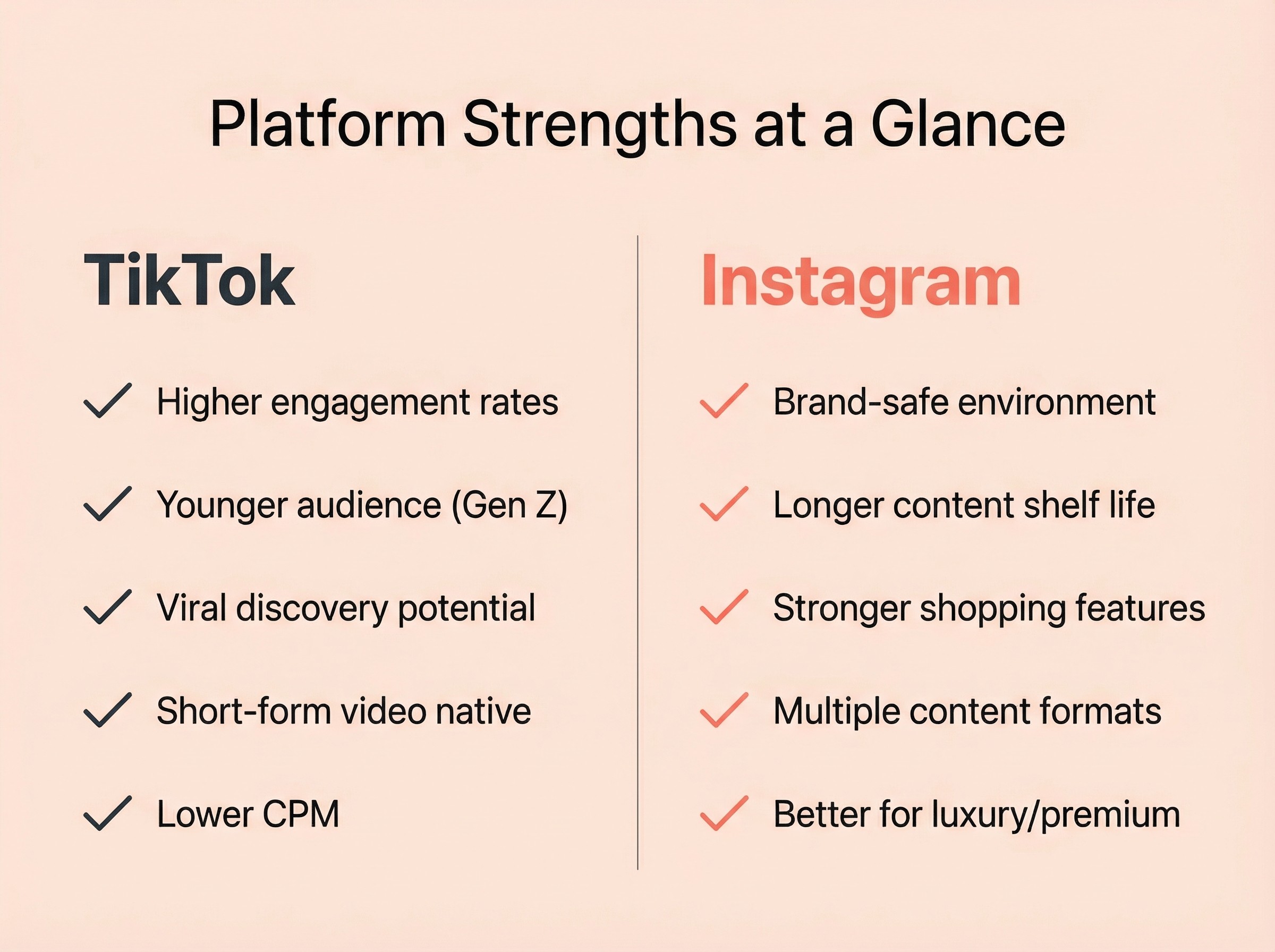
- Hashtag challenges and UGC campaigns: TikTok's Duet and Stitch tools make participation frictionless. Challenges generate massive volumes of user-created content that extends campaign reach far beyond the original creator.
- Product demos and tutorials: Authentic, unpolished demonstrations in beauty, food, tech, and home goods consistently outperform polished ads.
- New product launches and brand awareness: The algorithm surfaces content to non-followers by default, making TikTok the fastest path to reaching new audiences at scale.
- TikTok Shop and social commerce: Direct in-app purchasing with creator-driven affiliate links. LIVE shopping events see high conversion rates, particularly for impulse-buy products.
- Trend-based and sound-based content: Brands that attach to trending audio or formats gain organic amplification from the algorithm.
Instagram's Strongest Campaign Types
- Aspirational and lifestyle campaigns: Instagram's polished visual culture suits premium positioning in fashion, travel, luxury, and food.
- Multi-touchpoint campaigns: A single Instagram campaign can combine Reels for discovery, Stories for conversion, and carousels for education — covering the full funnel in one platform.
- Long-term ambassador programs: Instagram is better for community building and ongoing brand relationships. Followers on Instagram tend to have stronger parasocial connections with creators.
- Direct-response and conversion campaigns: Stories with link stickers, discount codes, and direct CTAs drive measurable conversions. This is Instagram's biggest advantage over TikTok.
- B2B and professional services: LinkedIn aside, Instagram's older skewing audience and professional creative tools make it more suitable for B2B influencer campaigns than TikTok.
Tracking and Measurement Differences
How you measure results differs meaningfully between platforms — and this matters for agencies and brands who need to prove ROI to stakeholders.
| Capability | TikTok | |
|---|---|---|
| Native analytics access | Free (all creator/business accounts) | Free (business/creator accounts) |
| Historical data retention | Longer-term | 90 days only |
| Video completion rate | Yes (detailed) | Limited |
| Traffic source breakdown | Yes (For You Page, profile, search) | Yes (Explore, hashtags, home) |
| Story-specific metrics | N/A | Yes (link clicks, exits, sticker taps) |
| Multi-format analytics | Single format (video) | Per-format (Reels, Stories, carousels) |
| Conversion tracking | TikTok Pixel (standalone) | Meta Pixel (cross-platform with Facebook) |
| Creator marketplace | TikTok One (invitation-based) | Creator Marketplace (Meta ecosystem) |
| Paid amplification of creator content | Spark Ads | Partnership Ads |
The biggest measurement gap: Instagram's native analytics only retain 90 days of data. If you're running quarterly or annual reporting — which most agencies are — you need a third-party tracking tool to maintain historical records. TikTok retains data longer natively.
The biggest measurement advantage for Instagram: Meta's attribution infrastructure is more mature. Because Instagram sits within the Meta ecosystem, cross-platform attribution (Facebook + Instagram + Audience Network) provides a more complete view of the conversion path. TikTok's Pixel works well for direct attribution but lacks Meta's depth in multi-touch modeling.
For agencies managing multiple campaigns across both platforms, a unified measurement tool like InfluenceKit consolidates TikTok and Instagram analytics into a single view — solving the data retention problem and making cross-platform comparison possible without manual exports.
When to Use Both: The Multi-Platform Strategy
Most brands in 2026 aren't choosing between TikTok and Instagram — they're using both with different roles.
The proven playbook:
- Test on TikTok first. Content is cheaper to produce and the algorithm gives fast feedback. Use TikTok to test messaging, product angles, and creator partnerships.
- Scale winners to Instagram. Take the concepts that performed well on TikTok and adapt them for Instagram Reels and Stories — with more polish and stronger CTAs.
- Use Instagram for retargeting. Users who discover a brand through TikTok often follow the brand on Instagram for deeper content. Stories and carousels nurture them toward conversion.
- Reserve Instagram Stories for direct response. Discount codes, limited-time offers, and link stickers perform best in Stories from creators who have already built audience trust.
Budget split guidance: A common starting allocation for brands new to multi-platform influencer marketing is 60% Instagram / 40% TikTok if the priority is conversions, or 60% TikTok / 40% Instagram if the priority is awareness and reach. Adjust based on performance data after the first 30 days.
Decision Framework: Where to Put Your Budget
Use this framework to guide your allocation based on your specific situation.
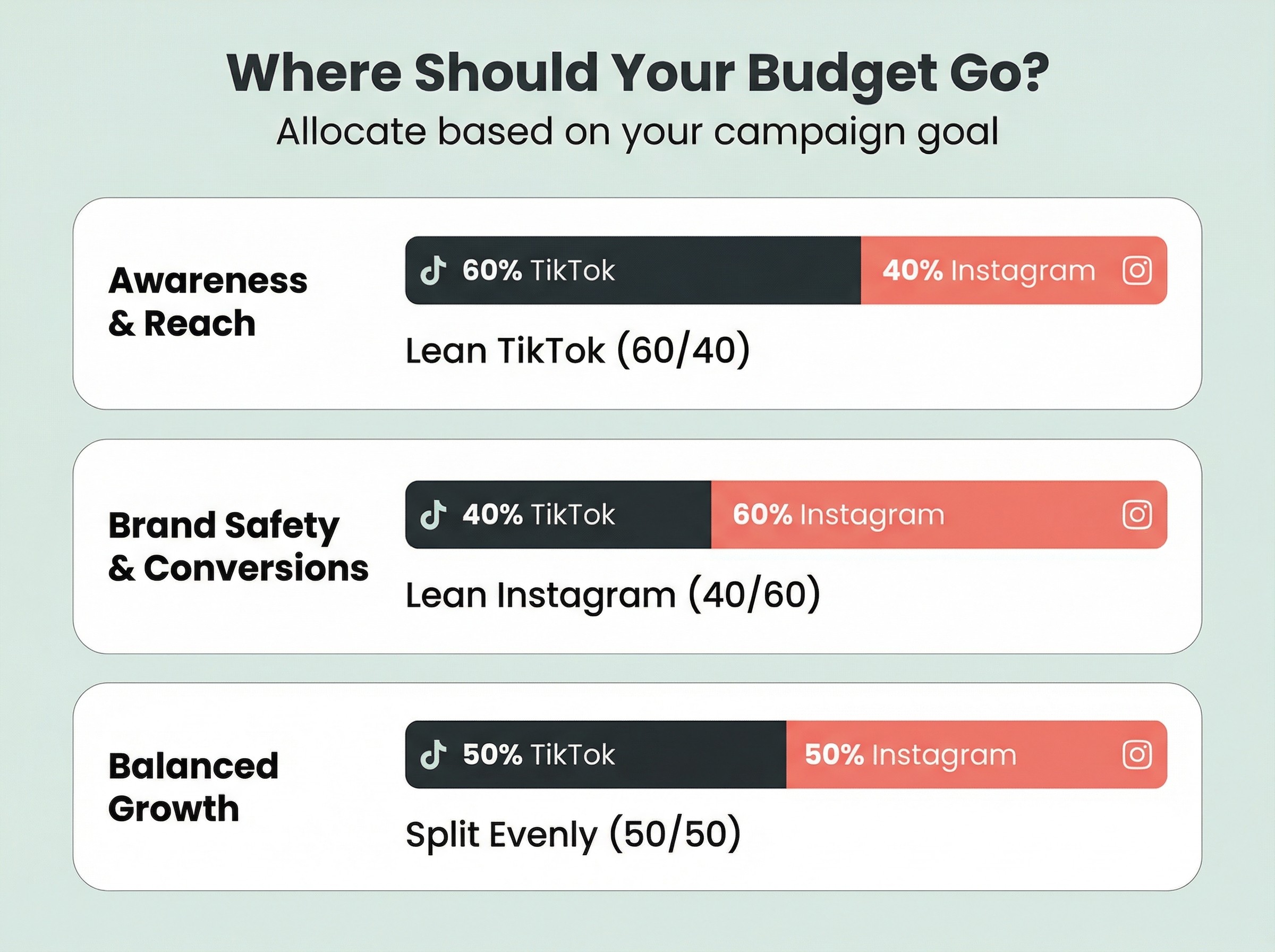
Choose TikTok-Heavy If:
- Your target audience is 18–34, especially Gen Z
- Your primary goal is awareness, reach, or brand discovery
- You're launching a new product or entering a new market
- Your product is visual and benefits from demonstrations
- You have a limited budget (TikTok's lower CPE stretches dollars further)
- You want to generate user-created content at scale
- You sell products suited to impulse purchasing
Choose Instagram-Heavy If:
- Your target audience includes significant 35+ demographics
- Your primary goal is conversions, direct response, or lead generation
- You're running long-term ambassador or loyalty programs
- Your brand positioning is premium or aspirational
- You need robust attribution and conversion tracking (Meta Pixel ecosystem)
- You want a multi-format campaign (Reels + Stories + carousels)
- You're in B2B, professional services, or luxury
Use Both Equally If:
- Your target audience spans 18–44
- You have budget for at least 5–10 creators per platform
- Your campaign runs for 60+ days (enough time to test and optimize)
- You want to maximize total reach while maintaining conversion pathways
- You're building a long-term influencer program (not a one-off campaign)
The Bottom Line
TikTok and Instagram aren't competitors in your influencer strategy — they're complements. TikTok is where audiences discover your brand. Instagram is where they decide to buy. The brands getting the best results in 2026 use TikTok's algorithmic reach and lower costs to cast a wide net, then use Instagram's mature conversion tools and multi-format ecosystem to close the loop.
Start by defining your primary campaign objective. If it's awareness, lean TikTok. If it's conversion, lean Instagram. If it's both — and it usually is — split your budget, test on TikTok first, and scale winners to Instagram.
Whatever your split, track everything in one place. Comparing performance across platforms with different analytics dashboards and data retention windows is a reporting nightmare. A unified measurement approach is the difference between knowing what's working and guessing.
InfluenceKit tracks influencer content performance across TikTok, Instagram, YouTube, and more — with unified reporting that makes cross-platform comparison effortless. See how it works →